Why trust EV Safe Charge?
We’ve worked in EV charging since 2016, installing, operating and developing charging solutions for automakers, businesses, utilities and other organizations. Our customers and projects have included organizations such as Jaguar, Porsche, Audi, Hewlett Packard Enterprise, Los Angeles Department of Water and Power, 20th Century Fox and others. Our recommendations draw on that experience and our evaluation of product quality, compatibility, safety and usefulness. We don’t necessarily test every product ourselves, and we’ll distinguish hands-on experience from professional evaluation. Learn more about how we evaluate products and partners
Affiliate Disclosure: EV Safe Charge may earn a commission if you purchase products through links on this page, at no additional cost to you.
Find the Right EV Charging Adapter
Match your vehicle, the charger you want to use, and the adapter you may need.
Use the table below to quickly identify the right adapter, then continue reading for more details, tips and product recommendations.
| Your Vehicle | Charger You Want to Use | Adapter You May Need |
|---|---|---|
| NACS / SAE J3400 | J1772 Level 1 or Level 2 charger | J1772 to Tesla EV Adapter |
| J1772 / CCS1 | NACS Level 2 charger | NACS-to-J1772 adapter |
| Compatible CCS1 | Compatible NACS DC fast charger | NACS-to-CCS1 DC adapter |
| Compatible NACS | CCS1 DC fast charger | CCS1-to-NACS DC adapter |
| NACS / SAE J3400 | NACS charger | No adapter needed |
| J1772 | J1772 Level 1 or Level 2 charger | No adapter needed |
| CCS1 | CCS1 DC fast charger | No adapter needed |
Note: The direction matters. An adapter that connects a J1772 charger to a NACS vehicle is different from one that connects a NACS charger to a J1772 vehicle.
Understand the Main EV Charging Connectors
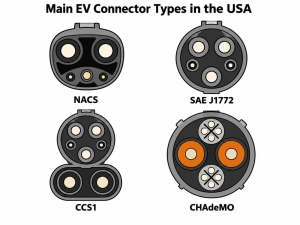
Most EV drivers in North America will encounter NACS / SAE J3400, J1772 and CCS1.
NACS / SAE J3400
The North American Charging Standard (NACS), standardized as SAE J3400, is used by Tesla vehicles and a growing number of other automakers. The connector can support both AC charging and DC fast charging.
J1772 (Level 1 & Level 2)
J1772 is widely used for Level 1 and Level 2 AC charging in North America and can be found on many EVs and existing home, workplace and public charging stations.
CCS1 (DC Fast Charging)
CCS1 combines the J1772 connection with two additional DC pins and is used for DC fast charging on many electric vehicles.
NACS / SAE J3400
What Is NACS / SAE J3400?
NACS stands for North American Charging Standard. The connector was originally developed by Tesla and has since been standardized by SAE as SAE J3400.
Unlike J1772 and CCS1, which use different connector configurations for AC and DC charging, the NACS/J3400 vehicle connector can support both AC charging and DC fast charging through the same compact connection.
Tesla vehicles have used this connector for years, and a growing number of other automakers are transitioning vehicles to NACS/J3400.
When might a NACS vehicle need an adapter?
If your vehicle has a NACS/J3400 charging port, you generally won’t need an adapter when connecting to compatible NACS charging equipment.
An adapter may be useful when you want to connect to other types of charging equipment:
Using a J1772 Level 1 or Level 2 charger:
You’ll need a J1772-to-NACS adapter.
Purchase a J1772-to-NACS adapter
Using a CCS1 DC fast charger:
Some compatible NACS-equipped vehicles can use CCS1 fast chargers with a CCS1-to-NACS DC fast-charging adapter.
Purchase a CCS1-to-NACS DC fast-charging adapter
DC fast-charging compatibility is vehicle-specific. Confirm that your vehicle supports CCS1 charging and the particular adapter before use.
Quick takeaway: If you have a NACS/J3400 vehicle, a J1772-to-NACS adapter can expand your Level 1 and Level 2 charging options. DC fast-charging adapters require additional compatibility checks.
J1772
What Is a J1772 Connector?
SAE J1772 is a widely used North American connector for AC electric-vehicle charging.
You’ll commonly encounter J1772 connectors on Level 1 and Level 2 charging equipment installed at homes, workplaces, hotels, parking facilities, shopping centers and public charging locations.
J1772 supports AC charging. It is not itself a DC fast-charging connector.
How does J1772 relate to CCS1?
This is a common source of confusion.
A CCS1 vehicle inlet incorporates the J1772 connection at the top and adds two larger DC pins below it.
That means a vehicle with a CCS1 inlet can normally accept a standard J1772 connector for Level 1 or Level 2 AC charging without an adapter. The additional pins are used when connecting to CCS1 DC fast-charging equipment.
When might a J1772 vehicle need an adapter?
If your vehicle has a J1772 charging inlet, you don’t need an adapter when connecting to compatible J1772 Level 1 or Level 2 charging equipment.
If you want to connect to a compatible NACS Level 2 AC charger, you may need a NACS-to-J1772 adapter.
Purchase a NACS-to-J1772 adapter
Important: A NACS-to-J1772 adapter for Level 2 charging does not allow a J1772 vehicle to use a Tesla Supercharger. Superchargers provide DC fast charging and require different vehicle capabilities and, where applicable, a DC fast-charging adapter.
Quick takeaway: J1772 is for AC charging. If you have a J1772 vehicle, a NACS-to-J1772 adapter can provide access to compatible NACS Level 2 chargers, but not NACS DC fast chargers.
CCS1
What Is a CCS1 Connector?
CCS1, or Combined Charging System Type 1, is a North American charging configuration designed to support DC fast charging while retaining compatibility with J1772 AC charging.
The easiest way to recognize a CCS1 vehicle inlet is by its shape: it incorporates the familiar J1772 connection at the top with two additional large DC pins below it.
This allows the same vehicle inlet to serve two purposes:
J1772 connector → Level 1 and Level 2 AC charging
CCS1 connector → DC fast charging
So if your vehicle has a CCS1 inlet, you don’t need a separate J1772 port. The J1772 connector plugs into the upper portion of the CCS1 inlet.
When might a CCS1 vehicle need an adapter?
You generally don’t need an adapter to connect a CCS1-equipped vehicle to:
- A compatible J1772 Level 1 or Level 2 charger
- A compatible CCS1 DC fast charger
An adapter may be required if your automaker supports charging your CCS1 vehicle from compatible NACS DC fast-charging equipment, including supported Tesla Superchargers.
In that situation, you may need a NACS-to-CCS1 DC fast-charging adapter.
Purchase an NACS-to-CCS1 DC fast-charging adapter
Because DC fast charging requires more than physical connector compatibility, verify that your vehicle, adapter and charging network are compatible before purchasing or using an adapter.
Quick takeaway: CCS1 combines J1772 AC charging with additional connections for DC fast charging. Some CCS1 vehicles can also use compatible NACS DC fast chargers with an appropriate adapter, subject to automaker and network support.






Follow Us!