 Guide to Home EV Charging. Should you use Level 1 or Level 2?
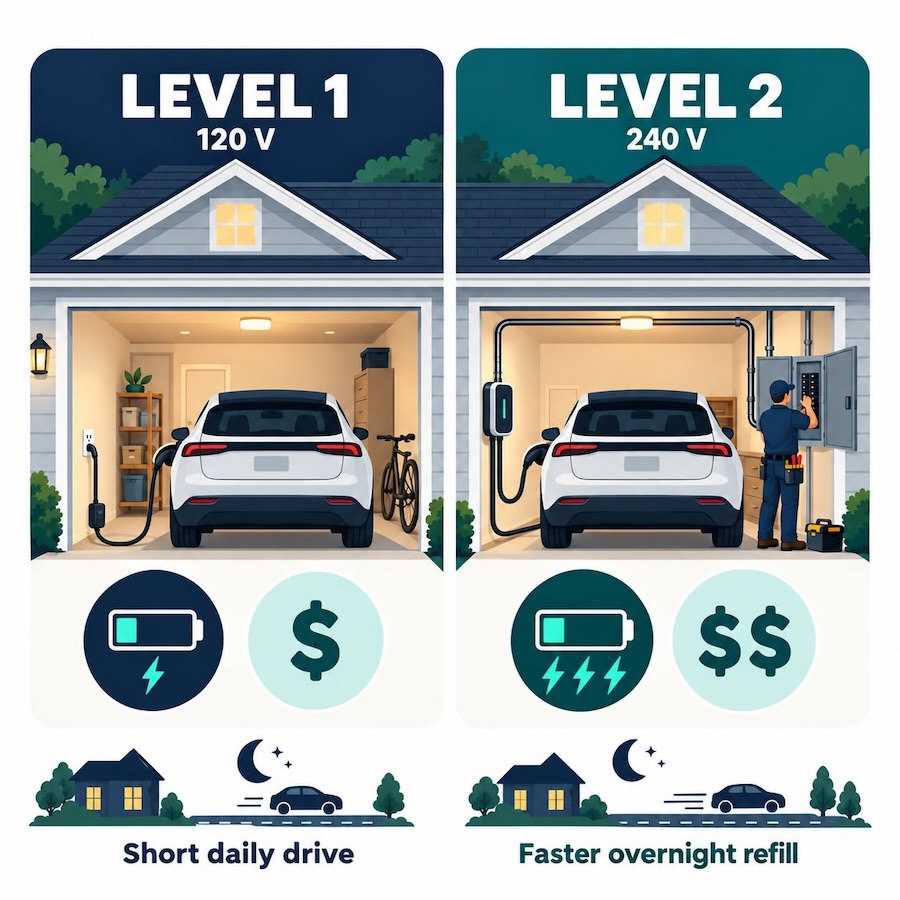
Home charging may be as simple as using a suitable 120-volt outlet or involve installing a faster 240-volt station. The right choice depends on how far you drive, how long your vehicle is parked, its AC charging limit, and your home’s electrical capacity. This guide is here to help you find the right home EV charger for your vehicle and situation.
Why trust EV Safe Charge?
We’ve worked in EV charging since 2016, installing, operating and developing charging solutions for automakers, businesses, utilities and other organizations. Our customers and projects have included organizations such as Jaguar, Porsche, Audi, Hewlett Packard Enterprise, Los Angeles Department of Water and Power, 20th Century Fox and others. Our recommendations draw on that experience and our evaluation of product quality, compatibility, safety and usefulness. We don’t necessarily test every product ourselves, and we’ll distinguish hands-on experience from professional evaluation. Learn more about how we evaluate products and partners
Affiliate Disclosure: EV Safe Charge may earn a commission if you purchase products through links on this page, at no additional cost to you.
Level 1 versus Level 2 |
Level 1 | Level 2 |
| Power source | 120V household circuit | Dedicated 240V circuit |
| Typical range added | Roughly 2–5 miles per hour | Often 10–30 miles per hour, sometimes more |
| Often suits | Short commutes, plug-in hybrids, long overnight parking, or a travel backup | Longer commutes, large batteries, shorter parking windows, or multiple drivers |
| Before buying | Check the outlet and circuit | Get an electrician’s assessment of the panel, circuit, permits, and total installation cost |
These rates are estimates. Your vehicle’s onboard charger, energy use per mile, and conditions determine the result. If Level 1 replaces the miles you drive each day, you may already have all the charging power you need. Some vehicles include a Level 1 cordset.
A note about 120V outlets: Use a grounded receptacle and follow the equipment instructions. The outlet’s shape alone does not establish that the wiring, condition, and circuit can support hours of charging. Avoid extension cords and power strips unless the equipment maker expressly permits a particular setup. Ask an electrician to evaluate an old or damaged outlet, an outdoor outlet, or a circuit shared with other substantial loads.
What matters when choosing a charger?
- Connector. U.S. vehicles commonly use J1772 or J3400/NACS for home AC charging. Match the vehicle’s inlet or confirm that an approved AC adapter supports the combination. CCS1 and CHAdeMO refer to DC fast charging connectors. EV Charging Connector Guide https://evsafecharge.com/ev-charging-adapter-guide/
- Power and circuit. More amps can charge faster only when the vehicle’s onboard AC charger and the home’s electrical system support them. Some products let an installer set a lower current; the maximum on the box is not the only setting. A 40A station commonly requires a 50A circuit; a 48A unit commonly requires a 60A circuit. Autel’s manual specifies a 70A circuit option for 50A charging. Have a licensed electrician determine the correct circuit, wiring, protection, output setting, and permits for the exact model and connection.
- Plug-in or hardwired. A plug-in Level 2 model needs a correctly installed, dedicated outlet that matches its plug. Hardwiring is common at higher outputs and for permanent outdoor installations.
- Practical fit. Check cable reach, outdoor rating, connector storage, access to Wi-Fi, warranty, and support.
- Smart charging. Scheduling can take advantage of lower overnight rates. App monitoring, energy history, and access control vary by product. Ask your utility about approved chargers and rebate rules before buying.
How do adjustable amperage settings work?
An adjustable charger can be set below its rated maximum when the vehicle needs less power or the approved installation calls for a lower limit. For example, the Autel MaxiCharger Home manual lists 16A, 24A, 32A, and 40A settings, plus 48A and 50A on the 50A hardwired model. The 40A models cannot exceed 40A. Lectron’s V-BOX Pro lists 16A, 32A, and 40A, plus 48A when hardwired. Lectron’s adjustable portable NACS Level 1/2 model lists 8–12A at 120V and 16–40A at 240V. Other Lectron units below are identified by their listed maximum; do not assume they offer the same adjustments.
The output setting, vehicle limit, and electrical installation must agree. A lower charger setting does not automatically make an existing outlet suitable; have the circuit and receptacle assessed. At 240V, 16A is about 3.8 kW, 32A about 7.7 kW, 40A about 9.6 kW, 48A about 11.5 kW, and 50A about 12 kW.
Compare home charging options
Each row below links one product configuration. Start with the vehicle connector and the outlet or wiring you have, then compare power, portability, cable reach, storage, and connected features. Autel’s home line uses J1772. Lectron offers both J1772 and NACS. The links currently go to manufacturer pages; EV Safe Charge will add its affiliate links before publication.
Level 1 and dual-level portable chargers
| Brand and model | Vehicle connector | Power and connection | Distinguishing feature |
| Lectron portable Level 1, 12A with app | J1772 | 120V, NEMA 5-15; up to 12A | 16 ft cord; Wi-Fi scheduling |
| Lectron portable Level 1, 12A with app | NACS | 120V, NEMA 5-15; up to 12A | Native NACS connector; 16 ft cord |
| Lectron portable Level 1/2, adjustable | NACS | 120V NEMA 5-15: 8–12A; 240V NEMA 14-50: 16–40A | Switchable plugs and current; 20 ft cord |
| Lectron portable Level 1/2, fixed maxima | NACS | 120V NEMA 5-15: up to 12A; 240V NEMA 14-50: up to 40A | Switchable plugs; 16 ft cord |
Level 2 wall units and portable chargers
| Brand and model | Vehicle connector | Installation and maximum output | Distinguishing feature |
| Autel MaxiCharger AC Elite Home 40A, 14-50, separate holster | J1772 | NEMA 14-50; up to 40A | Holster mounts separately |
| Autel MaxiCharger AC Elite Home 40A, 14-50, integrated holster | J1772 | NEMA 14-50; up to 40A | Holster built into the unit |
| Autel MaxiCharger AC Elite Home 40A, 6-50, separate holster | J1772 | NEMA 6-50; up to 40A | Different 240V plug; holster mounts separately |
| Autel MaxiCharger AC Elite Home 40A, 6-50, integrated holster | J1772 | NEMA 6-50; up to 40A | Different 240V plug; holster built in |
| Autel MaxiCharger AC Elite Home 50A, separate holster | J1772 | Hardwired; up to 50A | Higher maximum; holster mounts separately |
| Autel MaxiCharger AC Elite Home 50A, integrated holster | J1772 | Hardwired; up to 50A | Higher maximum; holster built in |
| Lectron NEXUS 40A, J1772 | J1772 | NEMA 14-50; up to 40A | 23 ft cord and separate J-hook |
| Lectron NEXUS 48A, J1772 | J1772 | Hardwired; up to 48A | 23 ft cord and separate J-hook |
| Lectron NEXUS 40A, NACS | NACS | NEMA 14-50; up to 40A | Native NACS connector; 23 ft cord |
| Lectron NEXUS 48A, NACS | NACS | Hardwired; up to 48A | Native NACS connector; 23 ft cord |
| Lectron V-BOX Pro with app | J1772 | NEMA 14-50: up to 40A; hardwired: up to 48A | Selectable 16/32/40/48A; 16 ft cord |
| Lectron portable Level 2, J1772 | J1772 | NEMA 14-50; up to 40A | 16 ft cord; app only on Wi-Fi variant |
| Lectron portable Level 2, NACS | NACS | NEMA 14-50; up to 40A | 16 ft cord; app only on Wi-Fi variant |
Autel’s six listed residential models share app scheduling and monitoring, a roughly 25 ft J1772 cable, and a three-year limited warranty. The two 50A versions require hardwiring. A NEMA 6-50 plug and a NEMA 14-50 plug are different: choose the exact product that matches the approved outlet. Models and features from both brands can change, and a manufacturer’s listing may show some variants as sold out. Check the availability before buying.
Installation, safety, and total cost
Look for a safety listing for the exact model from a nationally recognized testing laboratory. ENERGY STAR certification is a useful additional indicator where available. Budget for the full installation: panel capacity, wiring distance, mounting, outlet or hardwire connection, permits, and possible upgrades. An electrician can also advise whether a lower charging setting or compatible load management will meet your needs.
Check your utility for time-of-use rates, rebates, and approved product lists before ordering. Program terms and eligibility change.
Outside the United States
This guide and the linked products focus on U.S. homes. Other countries can have different voltage, plugs, certifications, and connectors; Type 2 is widely used for AC charging in Europe. Choose equipment approved for the country and ask a qualified local installer to assess the electrical requirements.










Follow Us!